
Quick Answer
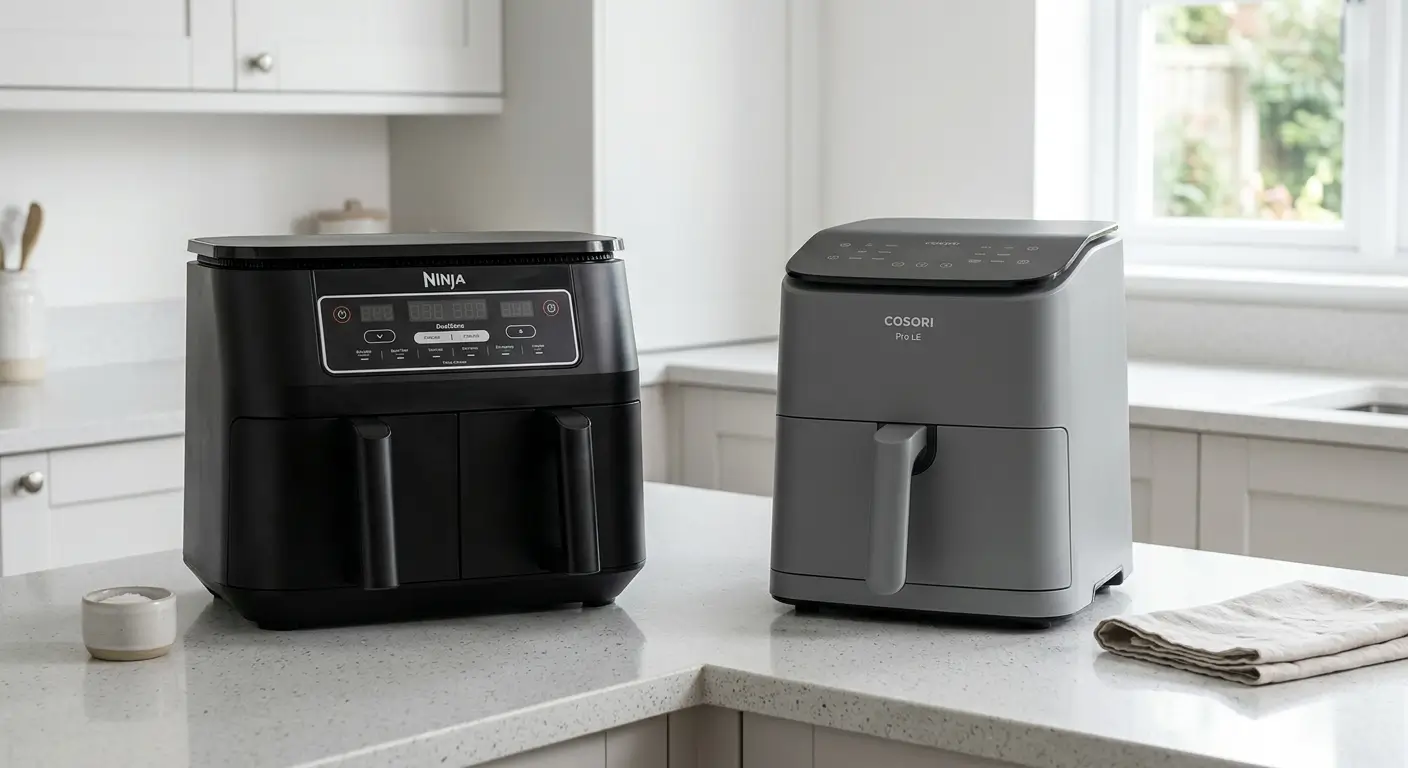
In the Ninja vs Cosori air fryer debate, Ninja generally wins for larger households thanks to its dual-zone baskets and higher total capacity, while Cosori wins for quieter operation, smart app connectivity, and more consistent single-basket results. Neither brand is universally “”better”—the right choice depends on how many people you’re cooking for and whether app control matters to you.
How Ninja and Cosori Compare Overall
Both Ninja and Cosori are among the best-selling air fryer brands, but they take noticeably different approaches. Ninja focuses on raw capacity and multifunction versatility, often at the cost of extra counter space and higher noise levels. Cosori focuses on precision, quieter fans, and smart features through its companion app, typically in a more compact single-basket design. Understanding this basic split is the fastest way to figure out which side of the Ninja vs Cosori air fryer comparison fits your kitchen.
Head-to-Head Comparison
| Factor | Ninja | Cosori |
|---|---|---|
| Typical Capacity | Up to 8 quarts (dual 4-qt baskets on DualZone models) | 5–6 quarts (single basket on most popular models) |
| Simultaneous Cooking | Yes — two independent zones with Smart Finish | No — single basket only |
| Noise Level | Noticeably louder during high-speed cycles | Quieter operation, some models rated under 55dB |
| App Connectivity | Manual controls only on most models | VeSync app with remote control and notifications |
| Preheat Speed | Fast, especially on smaller single-basket models | Fast, often slightly quicker to reach setpoint |
| Entry Price | Around $100 for compact single-basket models | Similar starting price range for comparable capacity |
| Best For | Families, meal preppers, cooking two dishes at once | Individuals, couples, smart-home households |

Where Ninja Wins
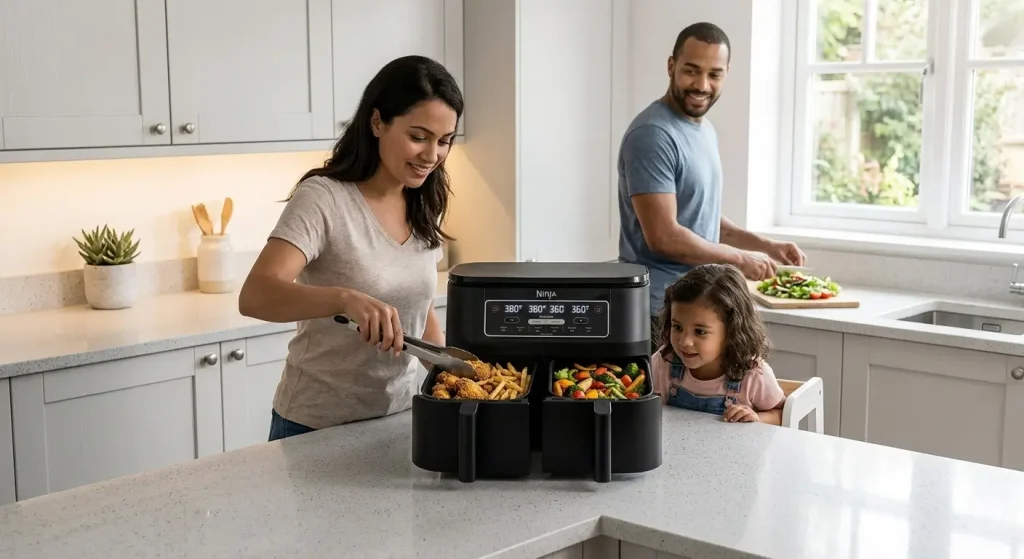
1. Dual-Zone Cooking for Families Ninja’s DualZone models split the cooking chamber into two independent baskets, each with its own time and temperature settings. This means you can air fry chicken in one basket while roasting vegetables in the other, and use the “Smart Finish” feature to have both ready at the same time — something no single-basket Cosori model can match.
2. Higher Total Capacity For batch cooking or larger families, Ninja’s combined 8-quart capacity across two baskets gives you noticeably more cooking volume than Cosori’s typical 5–6 quart single-basket models.
3. Broader Accessory Ecosystem Because Ninja has been on the market longer with more model variations, there’s a wider range of third-party racks, liners, and replacement parts widely available.
Where Cosori Wins
1. Quieter Operation Cosori has specifically engineered several models around lower fan noise, with some rated under 55 decibels — a meaningful difference if your air fryer sits near a living or dining area.
2. Smart App Features Cosori’s VeSync app allows remote monitoring, cooking notifications, and voice control through Alexa or Google Assistant on supported models — a feature category Ninja largely leaves out of its air fryer lineup.
3. More Consistent Single-Basket Results In single-basket cooking, Cosori’s more focused airflow design tends to produce slightly more even browning across the basket compared to some Ninja single-basket models.
4. Compact Footprint For smaller kitchens, Cosori’s single-basket models generally take up less counter space than Ninja’s larger dual-zone units.
Cooking Performance: What to Actually Expect
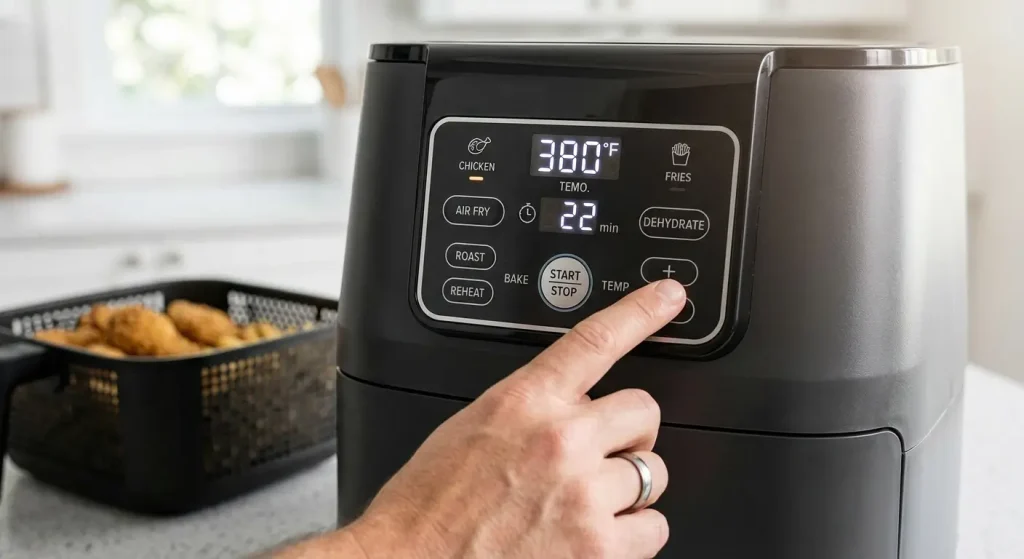
Beyond specs on paper, cooking performance is where most buyers actually feel the difference between these two brands. On frozen foods like fries and chicken nuggets, both Ninja and Cosori deliver similarly crispy results within a minute or two of each other — the airflow technology in both brands is mature enough that frozen convenience foods rarely reveal a meaningful gap.
The difference becomes more noticeable with fresh, raw proteins. Ninja’s dual-zone design means you can start a thicker cut of meat in one basket a few minutes before starting faster-cooking vegetables in the other, timing both to finish together — a genuine convenience for weeknight dinners that single-basket Cosori models simply can’t replicate. On the other hand, Cosori’s more focused single-chamber airflow tends to produce slightly more even browning on items like whole vegetables or single-layer proteins, since the hot air isn’t split across two separate zones.
Batch size is another practical factor. A Ninja DualZone model comfortably handles a full family dinner in one cooking session, while a single-basket Cosori often requires cooking in two smaller batches for the same total quantity — worth factoring in if you regularly cook for four or more people on a weeknight schedule.
Which One Should You Buy?
Choose Ninja if you:
- Regularly cook for a family or multiple people
- Want to cook two different foods at two different temperatures at once
- Don’t mind a larger footprint or slightly louder operation
- Prefer simple manual controls over app connectivity
Choose Cosori if you:
- Cook mainly for one or two people
- Want quieter operation, especially in an open-concept kitchen
- Like the convenience of app-based monitoring and voice control
- Have limited counter space
❓ Frequently Asked Questions (FAQs):
1. Is Ninja or Cosori better for a family of four or more?
Ninja generally wins here, since its dual-zone capacity lets you cook a full meal — protein and sides — at the same time, which single-basket Cosori models can’t do as efficiently.
2. Which brand is quieter, Ninja or Cosori?
Cosori is generally quieter, with several models specifically engineered for lower fan noise, while Ninja’s higher-capacity dual-zone models tend to run louder during high-speed cycles.
3. Does Cosori’s app actually make a meaningful difference?
For households that already use smart-home devices, the ability to get cooking notifications and use voice control adds genuine convenience. If you don’t use smart-home features elsewhere, this advantage matters less.
4. Which brand is easier to clean?
Both brands offer dishwasher-safe baskets on most models, so cleaning difficulty is fairly similar. Ninja’s dual-basket design means two parts to clean instead of one, but each piece is a similar size to a single Cosori basket.
5. In the Ninja vs Cosori air fryer comparison, which one preheats faster?
Both brands preheat quickly, generally within 3–5 minutes, with some Cosori models reaching setpoint marginally faster in side-by-side testing, though the difference is small enough that it rarely affects real-world cooking.
6. Can I cook the same recipes on both brands?
Yes. Both use the same fan-forced hot air cooking principle, so most air fryer recipes work on either brand with only minor adjustments to time or temperature based on basket size.
7. Which brand has better long-term reliability?
Both brands are generally regarded as reliable for several years of regular use, and neither has a significantly stronger reputation for longevity over the other based on available consumer feedback.
8. Is the price difference between Ninja and Cosori significant?
Entry-level models from both brands are similarly priced. The bigger price difference comes from capacity and features — Ninja’s larger dual-zone models cost more than Cosori’s compact single-basket options, reflecting the added cooking capacity.
Conclusion
The Ninja vs Cosori air fryer decision ultimately comes down to household size and what you value most. Ninja is the stronger pick for families who want maximum capacity and the ability to cook two dishes simultaneously. Cosori is the stronger pick for individuals or couples who prioritize quiet operation, smart features, and a smaller footprint. Both brands deliver reliable, crispy results — the real difference is in how they fit your specific kitchen and cooking habits.
🛒 Recommended Products
- Ninja Foodi 6-in-1 DualZone Smart XL Air Fryer — the dual-basket model featured in this comparison, ideal for families and meal prepping
- COSORI Air Fryer Pro LE 5.0-Quart — the compact, quiet single-basket model featured in this comparison, ideal for individuals and couples
Affiliate Disclosure: This article may contain affiliate links. If you purchase through one of these links, Smart Kitchen Vibe may earn a small commission at no additional cost to you.
Recommended Guides
- 5 Best Air Fryer Accessories Every Modern Cook Needs (2026)
- Is the Ninja AF101 Air Fryer Still Worth It in 2026?
- Smart Air Fryer vs Convection Oven: Which Wins for Ultimate Cooking?
References
- Ninja Kitchen Official Product Specifications
- Cosori Official Air Fryer Product Line
- Consumer Reports: Air Fryer Buying and Testing Guide
Editorial Note
Reviewed by the Smart Kitchen Vibe Editorial Team
This comparison is based on published manufacturer specifications for capacity, wattage, and noise ratings, combined with widely reported real-world testing patterns across both brands’ current model lineups, to help readers choose based on household size and feature priorities rather than marketing claims alone.